Here are the 6 steps for developing an impactful BCC programme strategy:
- Enabler and Barrier Assessment: The first step to a successful BCC programme strategy is to carry out research about the target audience, including an extensive assessment of the behaviour to be changed and the reasons underpinning it. This requires assessing their knowledge, attitudes, needs, and habits (where do they seek information? On what platforms are they engaged? etc.). Barrier and enabler analyses can be supported by participatory methods such as community mapping and focus group discussions (Thomas, 2010). Practitioners are then able to identify the critical bottlenecks to be addressed, e.g. physical, attitudes, or institutional etc.. (WaterAid, 2015). The Capability, Opportunity, Motivation, Behaviour (COM-B) Model is one methodology that is available and highlights the barriers for each area. The COM-B Model provides sample questions the practitioner should ask in identifying barriers for each area (Government Communication Service, 2021). The “Doer/Non-Doer” practical analysis framework developed by Bonnie (2013) focuses the enablers which have supported the early-adopters the desired behaviour change.
- Developing and Building BCC Materials and Campaign: This is the stage where the designers of the BCC programme decide the message and the communication channel for engagement and interaction with the specific target groups. The messages need to be adapted to the target audience, to their level of knowledge, their challenges, and their perceptions about what can and cannot be done. The messages should be concise, easy to understand, and delivered in a manner that directly applies to them and their behaviour. The F-Diagram is one of the most commonly used BCC materials used in the WASH sub-sector (Figure 2). It is a graphic illustration that describes the potential faecal oral communications pathways which is intended to encourage people to adopt the safe sanitation and hand washing behaviours.
Figure 2. F-Diagram. Source: WEDC (2013)
3. Pretesting: Once the BCC materials and the messages are prepared, pre-testing should be done for its effectiveness and motivation for change. To do so, conduct design workshops or focus groups involving key stakeholders, field workers, and members of the intended audience to also determine the best outlet for dissemination (i.e., print, radio, social media etc.) Then conduct a survey to determine if the produced materials meet the objectives of the programme, the needs of the audience, the message is clear and easy to remember and socially and culturally appropriate (SNV, 2016).
4. Implementation and Messaging: Implementation involves the distribution of created and tested content and messages, implementing the activities that reflect the new behaviour change (e.g., not dumping waste in rivers, hand washing with water and soap after defecations, using household water treatment) and training and capacity building of key players with the necessary skills for creating a multiplier effect for the desired behaviour change. Practical exercises and serious games can help carry out the messaging in a fun, interactive, and effective manner. Great examples have been developed for encouraging handwashing with soap (UNICEF, 2013) and safe menstrual hygiene management (WSSCC, 2016).
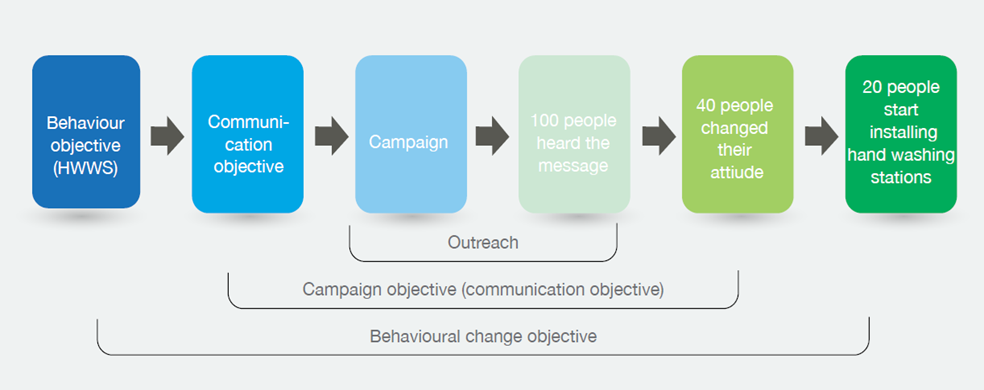
5. Monitoring and Evaluation: refers to the tracking of existing statistics related to the targeted behaviour, tracking outputs to ensure that materials are utilised as planned with desired effects, and tracking the reaction of the target audience to ensure that they are motivated by the materials to change their behaviour (e.g., levels of pollution in rivers over time, % of people reporting washing their hands with water and soap after defecations, and % of households with residual chlorine in their drinking water). Evaluation of the monitoring results will also help identify the lessons learned, where the programme is weak and needs revision, and where it is strong and should be replicated. Feedback from the target groups and stakeholders are absolute necessities as based on these feedbacks, new sets of knowledge can be incorporated into the participant’s lives thus laying the foundation for new sets of behaviour. Additionally, when measuring effectiveness, BCC specialists must make a distinction between three levels; change in behaviour, the communication objective, and the outreach objective (Figure 3).
Figure 3. Areas for Consideration when Assessing Effectiveness. Source: (SNV, 2016)